About This Documentation
Hammerspace unlocks a new tier of storage by transforming existing local NVMe storage on GPU servers into a Tier 0 of ultra-fast, persistent shared storage. By activating this previously 'stranded' local NVMe storage seamlessly into the Hammerspace Global Data Platform, Tier 0 delivers data directly to GPUs at local NVMe speeds, unleashing untapped potential and redefining both GPU computing performance and storage efficiency.
This innovation works with existing on-premises and/or cloud-based GPU (or CPU/ARM) servers from any vendor, by activating internal local NVMe capacity that has already been paid for.
This ultra-fast local NVMe capacity - which is largely underutilized - is a sunk cost, since it is already included within the price of GPU servers in both on-premises and cloud-based deployments. The fact that this also doesn’t add any additional power requirements is also a net benefit for data centers who are near the limit of their available power.
Activating this local NVMe as Tier 0 shared storage is done leveraging intelligence built into the Linux kernel, which is included in all standard distributions. This means that servers do not require installation of proprietary client software, or any other alterations as they are delivered from manufacturers.
Moreover, utilizing this local Tier 0 capacity reduces or can even eliminate the costs of adding extreme-performance networking infrastructure and/or additional external high-performance storage systems, all of which are very expensive ways of trying to lessen the impact of the network bottleneck when trying to keep the GPUs fully utilized.
Tier 0 delivers these benefits while also providing global multi-protocol file/object access, non-disruptive data orchestration, data protection, and other enterprise-class data services across a global namespace that unifies storage silos from any vendor in one or more locations, including hybrid cloud environments, accelerating time to value for AI investments.
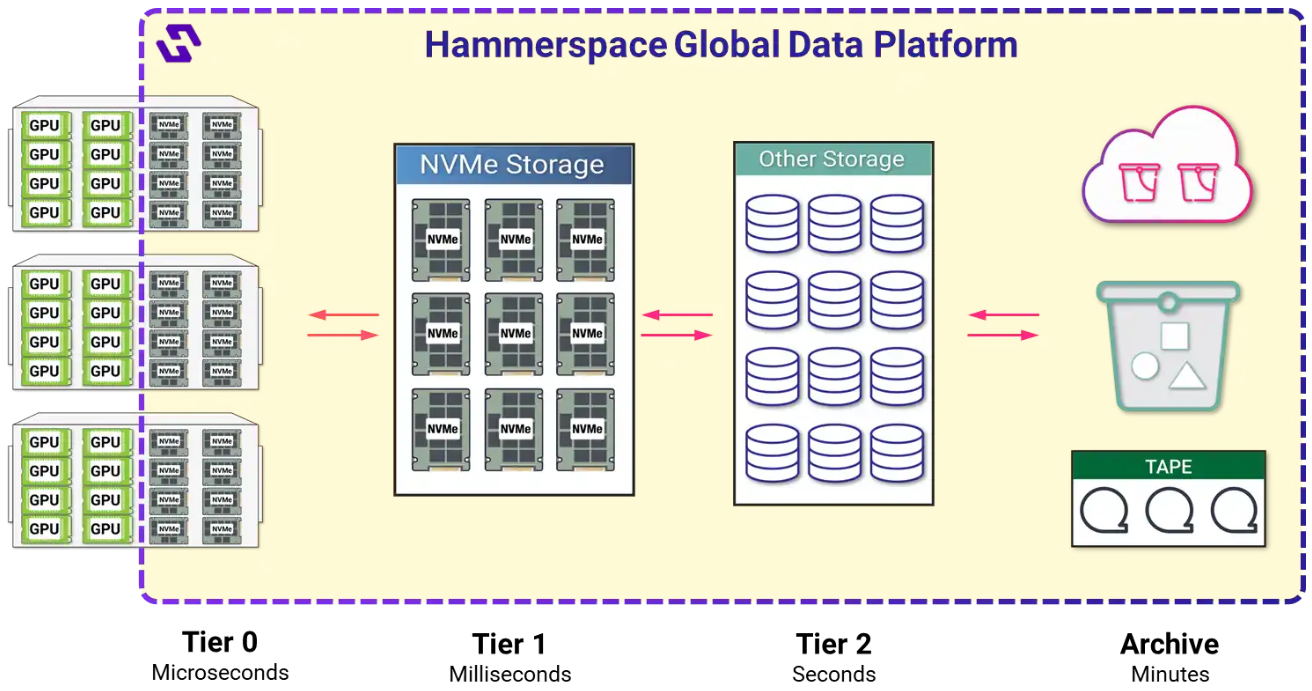
With Tier 0, organizations can fully leverage existing local NVMe on GPU servers as a shared resource, activating this higher-performing tier with the redundancy and protection of conventional external storage tiers. Moreover, utilizing this local Tier 0 capacity reduces or can even eliminate the costs of adding extreme-performance networking infrastructure and/or additional external high-performance storage systems, all of which are very expensive ways of trying to lessen the impact of the network bottleneck when trying to keep the GPUs fully utilized.
For support resources, see the Hammerspace Support Hub and the Hammerspace Licensing and Delivery Portal.
|
Do not install additional or third-party software, agents, or packages directly on Hammerspace Anvil (metadata) or DSX (data) nodes. These nodes run a managed appliance software stack; anything installed outside that stack is unsupported and is removed during a software upgrade. Such software can also interfere with node operation. If you need monitoring or integration with an external tool, contact Hammerspace Support for a supported approach. |